For the past 6 months, I’ve typed almost zero lines of code by hand.
So do I still call myself a coder? Kinda.
If your role is purely to code, you have to admit the job today is drastically different from 5 years ago. Here’s what I think the job has become.
Coding used to be 80% of the job
The dev’s role was to create code. About 80% of our time went to coding-related work.
But that never meant 80% typing. Half of it was really documentation: reading docs, understanding frameworks, learning new tech, weighing alternatives, designing.
The other half was the code itself. Writing it, making it compile, waiting for the compiler, fixing bugs.
Now it’s 20%, and shrinking
Agentic coding inverted that. Coding-related work is down to 20% of my time, probably less.
Whatever coding time remains goes to actually learning new technology, trying alternatives, or prototyping. Everything else, AI does better: it types 1000x faster than us, reads documentation better than us, picks up new frameworks better than us.
Agents aren’t flawless today. But there’s only one certainty: they will improve.
Which leaves a question nobody likes to ask out loud: where does the other 80% of our time go now?
For some pure coders, honestly? YouTube. (No judgment. Okay, a little judgment.)
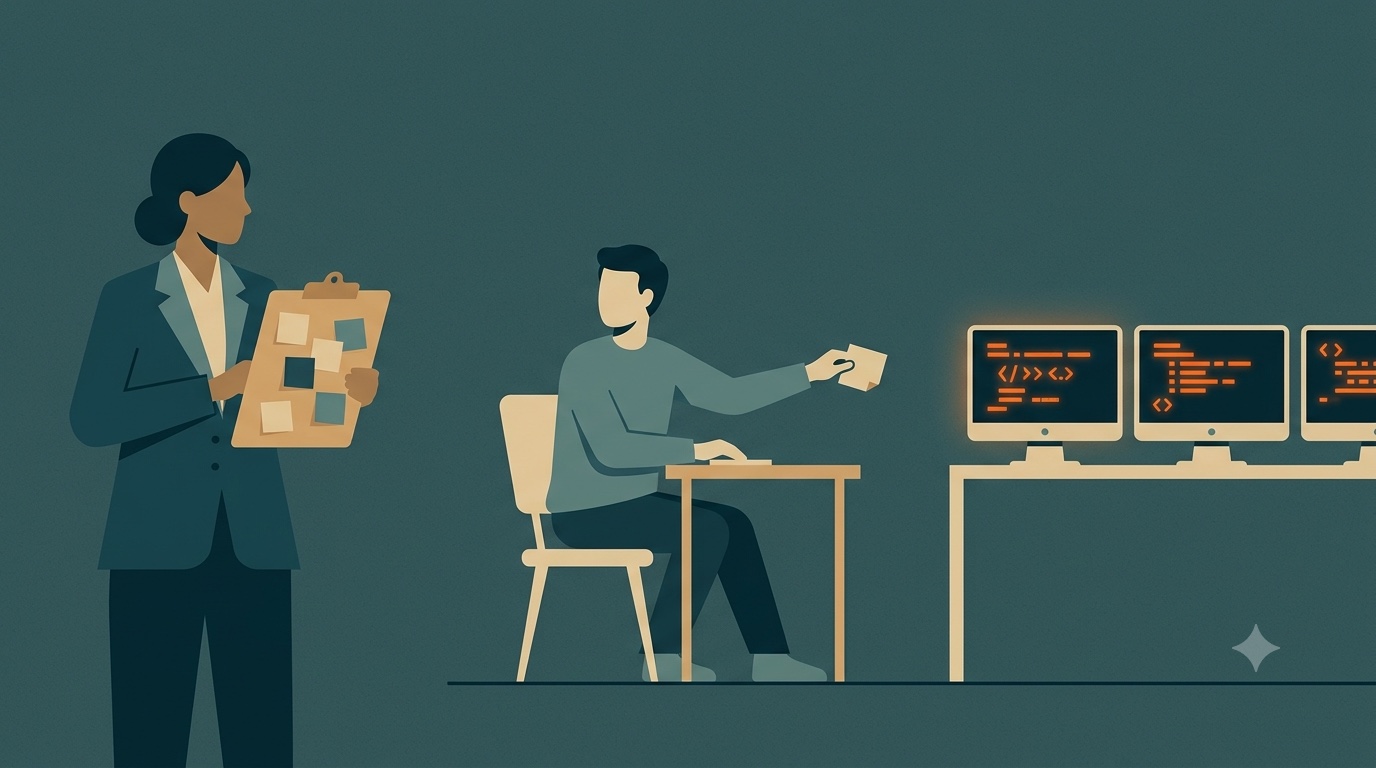
The dev is the new middle management
Before agentic coding, the PM was the middle management, sitting between the business and the devs and designers.
Now that the agent produces the code, the dev is the middle management. If you still have a PM, you sit between the PM and the AI (which is kind of silly when you say it out loud).
A dev who wants to slack off can literally just do this: record what the PM says, paste it into the agent as a prompt, then relay the agent’s questions back to the PM.
A human message bus.
So what do we do with the freed 80%?
The default company answer is “ship 5x more features”. But more features doesn’t mean a better product, especially features shipped without thinking and without testing.
Here’s what I think devs should do instead:
- Move toward product, design, and PM work. If your org has no PM (many strived to remove them even before AI), this is your opening. Fair warning: product sense takes taste. Taste comes from using a lot of apps, and from actually thinking about why one flow feels right and another feels off. Not every dev has it.
- Test more, not less. Agents can verify their own work to a point, but they don’t have a good pair of eyes. Handing everything untested to QA is just slacking with extra steps.
- Automate your own pipeline. An iOS dev can set up a daily routine that watches the Android PRs, checks if iOS is missing that feature, and starts building it for parity. Or one that watches the backend APIs for new endpoints worth building on.
That last one is the real unlock. When the bottleneck is waiting for someone to tell you what to build, go find the work yourself.
The bottleneck moved
After 6 months of working with Claude and Codex, most of my tasks finish at least 5x faster than before. The slowest part of my week is now waiting for product to decide what’s next.
$ git diff --stat
 247 files changed, 18432 insertions(+), 2103 deletions(-)
That used to be a whole sprint. Now it’s a Tuesday afternoon.
Which tells you where the value went.
Writing 10,000 lines of code doesn’t mean much anymore.
Producing 10 PRs a week doesn’t mean much anymore.
The person who can identify the problem, or the feature worth building, matters more.